
 27 Nov 2025

The 2025 Sustainability Summit opened with a powerful keynote from architect Kawai Yeung, whose work across the Pacific and with Aboriginal and Torres Strait Islander communities has shaped a practice grounded in respect, reciprocity and community-led resilience.
Her reflections offered a compelling reminder that the most sustainable and culturally enduring solutions arise not from imposing ideas, but from listening deeply to Country, culture and community.
Yeung began by taking audiences back to the earliest days of the practice she co-founded with David Kaunitz – a start defined not by conventional urban commissions, but by post-disaster reconstruction in the Pacific.
“When I worked with David… in countries that are tropical paradise but have been devastated by natural disasters… the strength and knowledge within those communities fundamentally reshaped our understanding of what architecture is.”
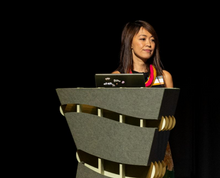
Kawai Yeung delivering the Keynote for The 2025 Sustainability Summit. Image: Coastal Creatives
Their practice Kaunitz Yeung was founded with a clear intention: to serve communities often overlooked – those with limited funding, difficult access, or recovering from emergency. Their first major project began in the Solomon Islands after the 2007 tsunami. From there, the work expanded to more than 40 Aboriginal and Torres Strait Island communities, and many others throughout the Pacific. These grassroots projects, Yeung explained, taught foundational lessons: resilience must be rooted in community, grounded in culture, and guided by Country.
Building with, not on top of
One of the keynote's most resonant moments was Yeung's reflection on the Takara School in Vanuatu, a project that became a living example of climate resilience shaped through cultural continuity. The practice adopted a local vernacular style of timber-framed buildings. Instead of importing materials for metal roofing, local women were paid to weave roofs from sago leaves – an approach that redirected development funding into households, supporting mothers and their children.
Through these choices, Yeung highlighted an essential truth: sustainable materials and traditional knowledge are not a compromise – they are a strength. “There's this incredible way of practice where we can provide the most sustainable approach… using natural, local, low-embodied-energy material, and also learning from them… and empower them for their self-determination.”
Resilience, she underscored, is not an end product. It is embedded through process, participation, and local capacity-building.
Challenging the status quo, patiently
Working across remote communities brings profound challenges – in logistics, funding, policy, and systemic inertia. Yeung acknowledged this with honesty: “We question the status quo, but we're patient, because change takes time… Instead of just designing, delivering and building, we see the process as opportunities.”
This philosophy has carried into their work with First Nations communities across Australia, including early projects like the Warnarn Clinic in the Gibson Desert and the Puntukurnu PAMS Healthcare Hub in Nyiyarparli / Martu Country – the first primary healthcare facility to serve the entire East Pilbara region from Newman, WA.
Designing for cultural continuity: 'Little Heaven'
A profound example of architecture as cultural sustainability came through Yeung's detailed account of the Yutjuwala Djiwarr Residential Aged Care facility in Yolŋu Country, Nhulunbuy NT. For decades, Elders were forced off Country for care – an absence that deeply affected cultural continuity and community cohesion.
Through years of deep, repeated participatory design – house to house, community to community, family to family – the team shaped a 32-bed aged care facility, including palliative care and dialysis, founded on one question: What is the most culturally appropriate aged care for Yolŋu people?
The resulting design broke away from institutional norms. Clusters of rooms arranged like palm fronds offered views to Country, cross-ventilation, adaptable kinship-based groupings, and deep verandas for outdoor sleeping.
This was architecture not as an imposed model, but as an expression of living culture. As Yeung described, “Finally, the Elders have their wish.”
The BAAKA Cultural Centre is located at 44 Reid Street Wilcannia. Image credit: Brett Boardman
Everything is Country, everything holds stories
Closing the keynote, Yeung brought the audience to Wilcannia, on Barkandji Country, where the Bakker Cultural Centre is being created on a site marked by deep colonial history. The community insisted the burnt-down colonial building be retained – something the team initially questioned. But Elder Eddie explained: many people, Indigenous and non-Indigenous, had worked there; it held their stories.
This moment revealed one of the keynote's most profound lessons: First Nations resilience is not only about rebuilding – it is about honouring all layers of history, even painful ones, and carrying them forward with generosity and hope. Long before “adaptive reuse” became an architectural trend, this principle was embedded in cultural practice.
Yeung described the community's willingness to move beyond grievances and focus on future generations as a powerful act of cultural stewardship. It was, she said, one of the greatest lessons her practice has ever received.
The Summit message: Resilience through relationship
Across every project shared, one message came through clearly: Resilience is not something delivered to communities. It is something created with them – through culture, through Country, and through the shared act of building futures together.
The 2025 Sustainability Summit opened with this reminder: sustainability is inseparable from social and cultural strength. And the most enduring knowledge comes from those who have lived in deep relationship with place for tens of thousands of years.
Be part of the next chapter
Sign up now to receive updates for the 2026 Sustainability Summit – where practitioners, thinkers, and community leaders will continue shaping the future of sustainable design grounded in culture, Country and collective resilience.