
 02 Apr 2026

New research from Crane Garden Buildings has found that buying storage space for the garden is a more financially astute option than paying ongoing fees for offsite storage. In fact, the typical cost of a garden building, which will last for ten years or more, is on average the equivalent of just one year paying London storage rates.
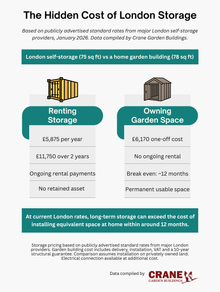
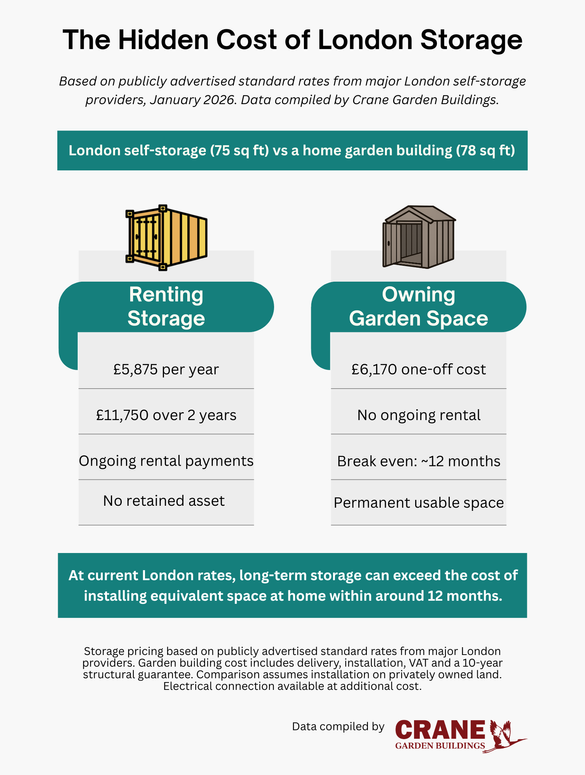
Based on rates advertised in January 2026 by major London storage providers, a standard 75 sq ft unit costs approximately £5,875 per year. Over two years, that equates to more than £11,750. Over a decade, cumulative rental costs exceed £58,000, with no residual asset at the end of the term.
While storage is often viewed as a short-term solution, industry data suggests usage frequently extends far longer. According to the Self-Storage Association UK (SSA UK) Annual Report 2025, 38 per cent of customers have been in their current unit for three years or more, with 8 per cent storing for nine years or longer. Around 40 per cent of domestic customers expect to remain in storage beyond 12 months.
The report also highlights that London storage costs represent the highest proportion of disposable income nationally, underscoring the relative expensive of long-term storage in the capital.
Comparing capital outlay
Using Crane Garden Buildings' latest figures, a 3m x 2.4m (approx. 78 sq ft) premium timber garden building, including delivery, installation, VAT and a 10-year structural guarantee is currently priced from £6,170. On a like-for-like basis, the break-even point versus London storage rental can therefore occur at approximately 12 months.
James Crane, Partner at Crane Garden Buildings, said: “Monthly storage payments can appear manageable in isolation. However, when viewed over five or ten years, the cumulative outlay becomes significant. For homeowners who already have land, it becomes a question of capital allocation – whether to continue renting space externally or invest in space that forms part of the property itself. There comes a point when investing in quality garden storage makes better financial sense than renting space.”
Ownership and long-term use
The growth of self-storage facilities reflects wider consumer demand for flexibility and low upfront commitment. However, SSA UK data indicates that storage is often not short-term in practice.
With more than a third of customers storing for three years or longer, long-term rental becomes a recurring household expense rather than a temporary bridge solution.
Over a decade, £58,000 in rental payments does not create a tangible residential asset. By contrast, a permanent outbuilding becomes part of the home's footprint and may serve multiple functions over time, including storage, workshop space, hobby use or secure equipment housing.
Karl McArdle, Co-Founder of The Property Buying Company, added: “From our experience buying and valuing thousands of properties across the UK, a quality garden room can realistically add up to 5% to a home's value, and in some cases more. On the average UK property, that translates to roughly £13,500–£15,000.
“What we're seeing is that buyers no longer treat a garden room as a nice-to-have; it's become a genuine selling point, particularly where it serves as a functional home office or self-contained workspace. The return on investment can be significant, especially when you consider that a well-built garden room typically costs between £5,000 and £15,000 to install.
“The important thing is build quality; a poorly finished structure can actually detract from a property's appeal rather than enhance it.”
Broader financial context
For homeowners with significant equity tied up in property, recurring storage payments represent an ongoing expenditure that does not accumulate into a residential asset.
The SSA UK Annual Report 2025 also identifies a perception gap around storage pricing: only around 10 per cent of the public accurately estimate the true cost of self-storage. At the same time, the proportion of customers who believe storage represents good value has fallen below 60 per cent for the first time since 2019.
Taken together, data suggests that while storage remains widely used, cost sensitivity and value perception are shifting, particularly in higher-cost urban markets such as London.
As interest rates, inflation and living costs remain under scrutiny, attention is increasingly turning towards how household capital is deployed, and whether long-term rental payments represent the most efficient use of available capital.