

 29 Nov 2016

Passive House (also known as Passivhaus) is the fastest growing energy performance standard in the world. Over the course of a year a Passive House typically uses up to 90% less heating and cooling energy compared to consumption in typical homes.
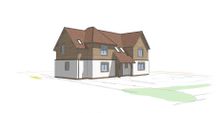
Award winning oak framed house builders 'Oakwrights' of Hereford have carried out successful preliminary air pressure tests on the UK's first Oak-Framed Passive House, which is being constructed in Yorkshire.
Oakwrights Certified Passive House Consultant David Bryan said: “We are often asked about eco-friendly new build designs which meet the planning requirements for energy efficiency and constructing to the Passive House standard can be the ideal solution.
“The key to the success of this type of building is having structural oak frame internally with an airtight, insulated envelope surrounding this, to avoid all penetration of this skin to reduce thermal bridging and possible issues with airtightness as the oak dries out.”
The Oakwrights team found that the preliminary air pressure test result gained this week were 0.4ach @ 50Pa which is 33% better than that required for Passive House requirements and also below the design limits of the property which will mean that potentially even less energy will be required than the original calculations in PHPP (the Passive House Planning Package) suggested.
“Passivhaus Design principals require a building to have a minimum airtightness standard of 0.6ach @ 50Pa (air changes per hour at 50 pascals); that means that a maximum of 60% of the entire volume of air in the building can be replaced by means of leakage around windows etc in one hour when the air pressure difference between inside and out is 50Pa. It is difficult to directly compare this to current Building Regulation standards as the units of measurement are different, however, this equates to slightly less than one tenth of the current requirement for new UK dwellings.
As these tests were carried out without the final internal finishing in place, it is usual that this result will improve once the building is complete so the company is looking forward to the final approval blower door test to see how much better it can get.
Oakwrights frames can be tailored to be Barn Style, Contemporary or Post & Beam internally to suit all tastes with the common element being a suitably insulated envelope, such as our WrightWall Natural, which utilises JJI-Joists and Warmcel insulation amongst other components to provide wall and roof panels with minimum U-values of 0.15W/m2K and 0.12W/m2K respectively. In our climate these should be sufficient to provide a good starting point for a Passive House design.
As is the case of any Passive House, or indeed a home built on the principles thereof, careful and thoughtful design can achieve an elegant, efficient building which can buck the perceived understanding that Passive Houses tend to be bland, boxy structures.
For high resolution images or further information about Oakwrights and the UK's first Oak Framed Passive House Project, please contact Michael Connolly, Marketing Manager at Oakwrights on 01432 361969 or Caroline Edmunds at Pennington PR on 01892 616647.
Notes to Editors
ABOUT OAKWRIGHTS
Based on the outskirts of the historic market city of Hereford and operating nationwide and abroad, Oakwrights are a multi-award winning company specialising in the design and construction of all styles of oak framed houses. Our unsurpassed reputation has been built on excellence of design, quality of product and professionalism of service. Widely recognised as the most progressive company in our field we have successfully combined the best of modern methods of manufacturing and state of the art technology with traditional craftsmanship, leading the way in 21st century oak framing.
Why Passive House?
- Extremely high levels of insulation
Reduces the annual consumption of energy to no more than the equivalent of 1.5 litres of oil or 1.5m³ of natural gas (15kWh) to heat each square metre of living space. Over the course of a year a Passive House uses up to 90% less heating and cooling energy as compared to consumption in typical building stock.
- Well-insulated door and window frames and glazing
Reduces the transmission of heat through the windows in both directions. Heat retention in the winter and exclusion in the summer equates to a constant internal temperature all year round. Careful attention has to be paid to shading or ventilating the larger openings to ensure comfort in the hotter months although this is not generally a great concern in our climate and can be addressed early in the design stages of the project.
- An airtight building envelope
The vast majority of heat loss in a domestic dwelling is through poorly sealed, draughty walls and roofs. Ensuring an airtight envelope through careful and considered construction, particularly when you are so close to the North Sea and in a direct line of sight to Denmark (although you can't actually see it!) means that the fabric of the house will deal with the worst a British Winter could throw at it without allowing any draughts to affect the living environment inside a Passive House.
- Thermal bridge free design and construction
Thermal bridges can be the downfall of even the best designed, thermally efficient house. A thermal bridge occurs where the structure of the building or a joint between two elements (e.g. wall and roof) has a reduction in insulation level. This allows heat to escape through this area and reduces the overall efficiency of the building. By addressing these areas at a very early stage in the process we can ensure that the thermal integrity of the entire building is not reduced once the building is being erected on site. This can be a particular challenge with an oak frame as the structural loads are borne by the relatively small area of the base of each post; on this property the Passive House certified floor construction has been adapted to give the required structural support without compromising the insulation in the floor build-up.
- Ventilation with highly efficient heat or energy recovery
Careful planning and execution is required with a Passive House to ensure a minimal energy demand, this can mean that a 20m² room can be kept warm by the body heat produced by 4 adults even in the depths of winter. By utilising a highly efficient heating and MVHR (Mechanical Ventilation with Heat Recovery) system, the internal environment is kept supplied with fresh air year-round whilst still keeping the total energy needed for heating and cooling extremely low.
Adapted from Active for more comfort: Passive House produced by the International Passive House Association and available to view here https://passivehouse-international.org/upload/ipha-brochure/