

 20 Mar 2014

Since the credit crunch, there has been increasing noise about crowdfunding or peer-to-peer lending.
Crowdfunding primarily started as a way of getting singers and rock groups into a financially viable position whereby they could record albums. Investors received little in return beyond free CDs.
However, the idea cottoned on: if a neighbour's son wanted funds to open a restaurant, then friends and family pitched in.
It then became increasingly commercial and the rewards became financial, as crowdfunding platforms sprang up online introducing investors to business opportunities and allowing people to pool their money to support businesses, organisations and individuals. And all without a bank in sight.
Funding Circle, for example, launched in 2010 because of two key problems: businesses were struggling to access finance and people were getting a poor return on their money. It has attracted over 72,000 people who have joined to lend money to businesses – so far, a total of nearly £235m.
For a number of small businesses, particularly start-ups, crowdfunding has been almost the only way to raise money in recent years. It is not just that crowdfunding is a source of money – it is a quick source, with funds typically made available within two to four weeks.
With banks notoriously reluctant and slow to lend to business ventures, the UK crowdfunding market is now worth millions – and growing.
According to think-tank Nesta, the alternative finance market, which includes all types of crowdfunding, grew by 91% last year from £492m in 2012 to £939m in 2013. Nesta thinks the market could grow to be worth over £12bn a year.
Crowdfunding is very much a child of our technological times: everything takes place online.
Businesses that want to raise money via crowdfunding apply to the platforms online, and provided they meet that platform's criteria, their requirements are posted up, complete with a timescale for investors to express their interest.
Until recently, property investment businesses were not major users of crowdfunding – but that is changing, with the likes of LendInvest, Crowdahouse, the House Crowd, Crowd Funded Property, Property Moose, and the latest, Crowdproperty and LaunchPad.
LendInvest has so far completed nearly £28m worth of loans, secured against properties worth nearly £44m.
LendInvest is also responsible for the largest crowdfunding loan in the world to date – £4.1m for a development of flats in Croydon, headed by Martin Skinner of Inspired Asset Management, who said: “What we needed was to move quickly and traditional lenders are too slow. Without the funding from LendInvest we would not have been able to complete our purchase in time.”
Those who backed Skinner through LendInvest have been offered 12% annualised interest.
Others offer rewards that put traditional savings accounts in the shade. Manchester-based House Crowd advertises 6% for those who want to see a combination of income and capital growth and 7.5% for those wanting to see income only.
Simon Zutshi of Crowdproperty is a seasoned property investor who has long believed in the concept of using other people's money. He says that using crowdfunding was the obvious next step for the property investment industry.
Simple concept
Property crowdfunding can be very simple: the property in question is advertised and people (ie, the crowd) pledge their support. If sufficient funds are raised, the property can be bought and the rewards – rental income or the gain after refurbishment and sale – distributed after costs.
Unlike much crowdfunding, property offers a very special attraction: the investors get ownership of actual bricks and mortar. So, while there is no guarantee that the venture will succeed, investors do actually have a solid asset.
Property crowdfunders can spread their risk along with other investors and will be likely to build up a larger portfolio than if there was just one solo investor.
Also, they can buy into property cheaply: £5,000 is typically all you need, according to Crowdahouse. Housecrowd quotes £1,000 and Property Moose sets the bar at just £500.
The biggest challenge for investors is trust. Can you trust someone who has taken your money not to disappear with it into the sunset? Until now, this issue has not been helped by the fact that crowdfunding has been almost entirely unregulated in the UK. This changes in April, with new rules being brought in by the Financial Conduct Authority.
The Budget
Peer-to-peer lending will be allowed within tax-free individual savings accounts (Isas) for the first time in what providers have hailed as a “seminal moment” for the nascent industry.
Different types of crowdfunding
The FCA stresses that its new rules will protect consumers and not stifle what it calls an 'innovative' method of funding.
The two forms of crowdfunding being regulated are:
- Loan-based (or peer-to-peer lending): lending money to individuals or businesses in the hope of a financial return such as interest payments. The FCA says 90% of crowdfunding is currently through peer-to-peer platforms.
- Investment-based: investing directly or indirectly in new or existing businesses by buying shares or debt securities or units in an unregulated collective investment scheme. Investment-based crowdfunding is considered by the FCA to be higher risk than peer-to-peer lending.
There is nothing to stop people simply giving money or hoping that in return for supporting a band they will get a CD.
New rules
The new rules for peer-to-peer crowdfunding platforms mean that consumers will have to receive explanations of the key features of the loans plus an assessment of the creditworthiness of the borrowers seeking funds. Platforms will not be allowed to play down any risks. Promotions must be fair, clear and not misleading.
The platforms will need plans in place to ensure loan repayments continue, even if the company raising the funds collapses. There will also be a 14-day cooling-off period.
Investment-based crowdfunding is already regulated but new rules will also kick in here: these investments can only be promoted to those who understand the inherent risks or have the financial capacity to cope with any losses. In other words, investors must be sophisticated and wealthy.
Importantly, they will not be able to invest more than 10% of their available assets, excluding their home, pensions and life cover.
Pros and cons
According to John Corey of Chelsea Private Equity, who is himself looking to launch a property education business using crowdfunding, this source of alternative finance has pros and cons.
For example, the public effectively do their own underwriting and trading. As Corey points out, it is an inviting feature for investors – but they do not have the expertise of City professionals, do not do multiple trades on a daily basis and are unused to due diligence.
Corey also says that crowdfunding started out as something that appealed to friends and family. The difficulty now is that it could appeal to “friends, family and fools – and that is where it starts to break down potentially”.
He adds that crowdfunding will not be for everyone. For businesses wanting to raise funds, the transparent nature of crowdfunding, which involves a public pitch, could be an issue. Anyone seeking crowdfunding will have to make their plans public, allowing competitors to see what they are doing.
Case study 1
Frazer Fearnhead began the House Crowd in March 2012, inviting investments from £1,000. The idea was for investors to club together to buy distressed or repossessed properties, do them up, rent them out – and sell them once their value had gone up by a certain amount.
Investors are promised a fixed return of 6% per annum, and a pro rata share of 50% of the profit made when the property is sold. The other 50% is how the business makes its money.
Two years on, how is the business going? There are, he says, 412 investors who between them have raised £3.4m and bought 50 properties outright.
There are, he says, advantages to crowdfunding. These include much lower costs to get on the property investment ladder; using Fearnhead's own experience to get the best deals; hassle-free, since all the properties are managed by Fearnhead's own team; bypassing banks and no small print; and good liquidity – he says that if an investor wants to quit, their shares are easily sold to new or existing crowdfunders.
However, he acknowledges the disadvantages: the decision to sell a property can be cumbersome, as it requires a 51% majority vote. Until now, properties have been sold to a formula – if they achieve 25% above their post-refurbishment value, they are put on the market. However, now it is the investors who decide whether to hang on to a property in the hope of further appreciation or to sell it now.
He also admits that a dedicated property investor will make more money on their own – providing they want all the work that goes with it.
House Crowd started with two-bed properties in Greater Manchester. However, the last purchase was a four-bedroom property and Fearnhead is now planning to take the business national.
Case study 2
Simon Zutshi has a buy-to-let portfolio of around 30 properties but in the last few years he has become increasingly interested in larger projects – for example, developments such as one in Redcar where a commercial property is being converted into 20 flats or a former pub in Oxford with redevelopment potential.
Zutshi already works with other private investors pooling funds, and this is what has sparked his interest in launching Crowdproperty. Rewards for lenders will be 6% or 10%, depending on the type of project.
“We will have very tight criteria as to what we will accept, but we might well fund something that a bank wouldn't,” he says.
Zutshi emphasises: “Our focus will be on protecting the interests of our clients. If any of our borrowers fail to make a payment, we will step in to make the payments and complete the project ourselves.”
* There will be a debate and Q & A on crowdfunding at the Property Investor Show, taking place at ExCeL, London, on April 11th and 12th.
The Property Investor Show is the largest event in the UK serving landlords and intending property investors and presents 100+ exhibitors and 70 educational and topical seminars and debates. See www.propertyinvestor.co.uk
Notes to Editors:
This article is written by Rosalind Renshaw on behalf of The Property Investor Show and may be published subject to reference to the event web site and show dates.
Image caption
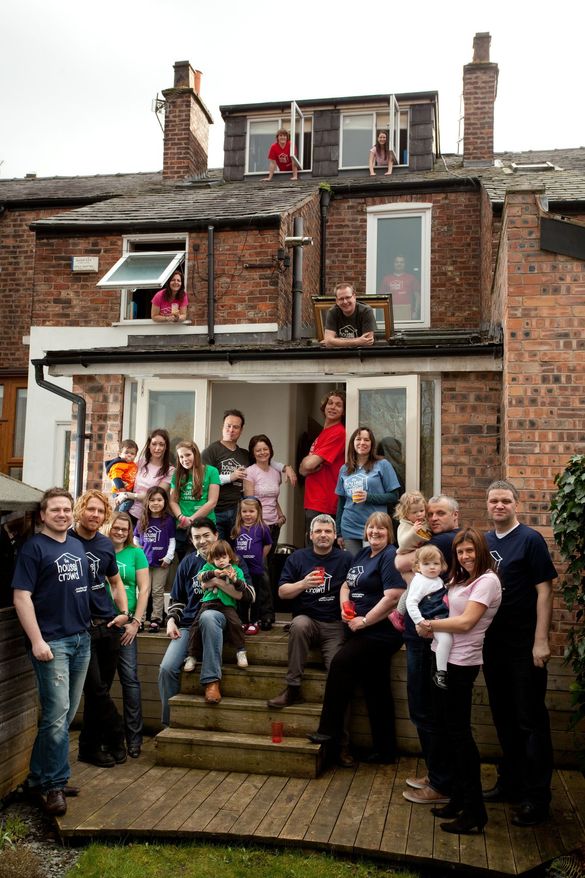
The Housecrowd at one of their investment properties
For further information please contact Nick Clark nick.clark@propertyinvestor.co.uk