

 26 Jul 2007

A striking concert hall in Portugal, a modern pavilion in Windsor Great Park, the reconstruction of London's Young Vic Theatre and the redevelopment of Dresden Station are among the six buildings which have made it on to this year's Royal Institute of British Architects shortlist for The RIBA Stirling Prize in association with The Architects' Journal. The £20,000 prize is awarded to the architects of the building that has made the greatest contribution to British architecture in the past year.
William Hill are again offering odds on the shortlisted buildings. The six buildings competing for this year's title are:
America's Cup Building, Valencia, Spain by David Chipperfield Architects (odds:3/1) Casa da Musica, Porto, Portugal by Office for Metropolitan Architecture (odds:3/1) Dresden Station Redevelopment, Dresden, Germany by Foster + Partners (odds:3/1) Museum of Modern Literature, Marbach am Neckar, Germany by David Chipperfield Architects (odds:5/1) The Savill Building, Windsor, by Glenn Howells Architects (odds:5/1) Young Vic Theatre, London SE1 by Haworth Tompkins (odds:7/1)
All shortlisted buildings can be seen at www.architecture.com and www.ajplus.co.uk.
Jack Pringle, RIBA President, said today:
“With the Stirling Prize now into its 12th year, the shortlist once again presents us with a fantastic range of projects and the tremendously difficult task for the judges to choose a winner. Three very different art centres are in the running – Porto's striking concert hall Casa da Musica, the Museum of Modern Literature in Germany and the re-designed Young Vic Theatre in London. They compete with the redevelopment of the late nineteenth century Dresden railway station by Foster + Partners, a modern park pavilion and visitor centre in Windsor Great Park and the America's Cup building, the centrepiece of Valencia's re-organised old industrial port.
“These ambitious projects are the very best in contemporary architecture, reflecting the work of our members in Europe as well as the UK. The RIBA's best architects have long found some of their most interesting commissions in continental Europe – but perhaps it's up to UK clients to ensure a better representation of buildings in Britain in future years' shortlists.”
The RIBA Stirling Prize jury, which will visit all six shortlisted buildings and then meet for a final time on the day of the presentation to pick the winner, comprises architecture specialists and lay judges from the arts. The 2007 judges are Tom Bloxham MBE – chair, Urban Splash; Alain de Botton – author and philosopher; Louisa Hutton – architect; Kieran Long – Editor, The Architects' Journal and Sunand Prasad – architect and RIBA President (from 1 September 2007).
The winner of the The RIBA Stirling Prize in association with The Architects' Journal will be announced at the Roundhouse in north London on Saturday 6 October, televised live on Channel 4 between 8 and 9pm.
Previous winners include Barajas Airport by Richard Rogers Partnership, The Scottish Parliament by EMBT / RMJM Ltd, 30 St. Mary Axe by Foster + Partners, the Laban Centre by Herzog & de Meuron, Gateshead Millennium Bridge by Wilkinson Eyre Architects, and Peckham Library and Media Centre by Alsop Architects.
This year's RIBA Stirling Prize is presented in association with The Architects' Journal. The evening's Associate Sponsors are Autodesk and SIV Architectural Career Management.
-Ends-
Notes to Editors:
2. The RIBA Stirling Prize in association with The Architects' Journal is the UK's most prestigious architectural prize and is awarded annually to the architects of the building which has made the greatest contribution to British architecture in the past year. Winners must be RIBA members and the building may be anywhere in the European Union. The prize is named after the architect Sir James Stirling (1926 – 1992). The winner will receive £20,000.
3. Brief citations for each shortlisted building follow:
America's Cup Building Valencia, Spain by David Chipperfield Architects
The building and park were the social focal point for the 2007 America's Cup, the world's premier sailing racing competition, staged in Europe for the first time in over 150 years. It is also the centrepiece of the re-organised old industrial port of Valencia.
The building is a stacked concrete structure with white steel trim; a ceiling of white metal panels; external floors of solid timber, and internal floors of white resin. The challenge will be to find new uses for the building when the America's Cup circus has moved out of town, but it has an inherent flexibility. For the meantime we can enjoy it for what it is: a sporty and nautical building, very light on its feet and thoroughly appropriate to its function.
Casa da Musica Porto, Portugal by the Office for Metropolitan Architecture
The Casa da Musica concert hall is a building full of scenographic moments and ironic gestures. A series of spaces, sequences and staircases negotiate their way around the auditorium. Aluminium-clad steps rise and turn, following the beautifully made concrete shell – the space sometimes soaring up to the roof, crossed by the forms of smaller rooms above.
The auditorium is a fixed-rake box whose design is determined by acoustics. The ends are defined by double-skin walls of sinuous corrugated glass. They provide acoustic enclosure and dramatically distorted views to the outside. The side walls are punctuated by more large windows of rippling glass giving views into and from other key spaces in the building.
This is a well-made building which is intriguing, disquieting and dynamic. It provides excellent spaces for the performance of all kinds of music, and fulfils another contemporary role as a strange, enigmatic and compelling object in the urban form of the city of Porto.
Dresden Station Redevelopment Germany by Foster + Partners
Although not totally destroyed by allied bombing during the infamous Dresden Raids, the station was badly damaged and suffered further from unsympathetic repairs and alterations. It is symbolically appropriate that the new work should have been designed by a British practice. Foster + Partners won the competition on the strength of their proposal to re-roof the damaged late nineteenth century train shed with a lightweight fabric roof, instead of reproducing the heavy timber and glass roof that had previously existed. This allowed a light touch to the repair of the steelwork, as well as providing 13% more natural light. The re-glazing and plaster stripping to reveal the brick walls are successful. The removal of later elevation alterations and ornamental adornments are nicely judged. The people of Dresden are highly appreciative of the work that has been carried out.
The Museum of Modern Literature Marbach am Neckar, Germany by David Chipperfield Architects
Following re-unification, texts of German authors previously dispersed to east and west have been brought together in this new museum. The entrance sequence is brilliant. The visitor crosses an open terrace overlooking the valley, then negotiates a series of shallow steps to enter through giant hardwood doors. A staircase descends to the collections with their required diminishing light levels. The route concludes in the permanent collection. Here glass cases, containing original manuscripts, form a magical flickering landscape.
There are many things to praise about this building - the architect's control and discrimination in the choice of materials has by now become a signature - but above all it is in the handling of the 'difficult whole' that the building excels.
The Savill Building Windsor Great Park by Glenn Howells Architects
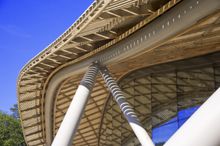
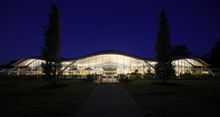
This project is a good modern interpretation of that great British traditional form: the 'pavilion in the park'. The Savill Building, a Visitor Centre that creates a gateway to the listed gardens, takes the form of a dramatic gridshell structure made of timber from Windsor Park in which it sits. This innovative use of traditional materials means that it harmonises well with a skyline of mature trees, as well as being an object of great beauty and grace in its own right.
The roof is a distinctive undulating form. It ripples over everything, the gridshell twisting and turning like bones beneath an animal's skin. The client wanted a landmark. What they have got is an appropriate response, in a modern idiom, and they are delighted.
Young Vic Theatre London by Haworth Tompkins
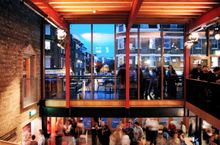
The Cut is a cheerfully scruffy part of south London into which, in the 1970s, architect Bill Howell introduced the Young Vic at a cost of a mere £60,000. Times and prices change, but Haworth Tomkins have remained true to the ad-hoc aesthetic of the original while radically expanding opportunities for actors to make theatre and audiences to enjoy it.
The existing auditorium has been painstakingly reconstructed to satisfy new technical requirements yet retain the audience/performer relationship that distinguished its predecessor. The judges agreed that this project's merit, demonstrated by its very detailed and careful response to the challenge of remaking somewhere that so far as its audience was concerned had never been broken, was an achievement that demanded recognition.
4. Established in 1895, The Architects' Journal has consistently been at the forefront of architectural publishing. Its weekly news coverage, comprehensive building studies and in-depth technical and practice features make it essential reading for the profession, and its incisive commentary makes it a must-read for opinion formers. The AJ is the UK's leading independent architectural magazine, whose authoritative voice has informed generations of architects. For more information on the RIBA Awards visit the AJ website at www.ajplus.co.uk
5. The RIBA Awards and RIBA Stirling Prize are managed by the RIBA Trust. The RIBA Trust manages the cultural assets of the Royal Institute of British Architects (RIBA), including the internationally recognised collections of the British Architectural Library. It is the UK's national architecture centre, delivering the RIBA Awards and RIBA Stirling Prize (live on Channel 4); the Royal Gold Medal; International and Honorary Fellowships; Architecture Week (with Arts Council England and the Architecture Centre Network); a full programme of lectures, exhibitions, tours and other events; and an education programme.
6. An exhibition presenting this year's shortlist will be on display from 14 September - 24 November 2007 at the RIBA, 66 Portland Place, London. Admission free. Please visit www.architecture.com for opening times and further details.
7. For further information go to www.architecture.com
For further information, images and extended citations please contact Lorna Gemmell in the RIBA Press Office Tel: 020 7307 3761 Email: lorna.gemmell@riba.inst.org